CONCEPT CASE STUDY — CAPSTONE PROJECT
ROLE
Tools
Course
DURATION

01 / OVERVIEW
An AI-powered gaming companion that turns decision fatigue and menu-hunting into contextual, in-platform guidance — across any console or PC. Instead of alt-tabbing to Google a boss fight or losing ten minutes to a storage warning, a player gets what they need without leaving the game: “You’ve got about an hour — want to continue Ghost of Tsushima, or knock out that last trophy in Horizon?” No searching, no context-switching.

02 / THE PIVOT
This started as a PlayStation-specific concept — voice-first wireframes exploring how an AI assistant could sit inside a single console’s ecosystem. An early AI-generated direction used real PlayStation branding without the tool raising any concern. The concept was generalized from there into GameGuide AI: cross-platform, IP-safe, and its own identity, even down to using a fictional in-game world, “Elden Realm,” in the prototype screens.

03 / RESEARCH
Two semi-structured interviews with console and PC gamers explored interruption behavior, trust, and AI assistance opportunities — honestly a small sample and a starting point, not proof. Players interrupt gameplay for different reasons; contextual guidance beats generic advice; and voice suits quick questions while visuals suit detailed decisions.

04 / COMPETITIVE RESEARCH & BUSINESS CASE
A structured evaluation compared GameGuide AI’s intended space against Erica, Xbox Voice, and Discord’s Clyde AI. Nothing combines personalized trust with LLM flexibility for gaming specifically. The objective is to remove the friction that causes players to disengage mid-session, measured through weekly active sessions, time-to-play, task success, helpfulness, and recommendation trust.
05 / ETHICS & ACCESSIBILITY
Recommendations serve player goals, not monetized content. Privacy is scoped to personalization needs; Spoiler Mode is player-controlled; every response carries a visible BETA label. The experience targets WCAG 2.1 AA minimum with voice interaction, colorblind-safe accents, and explicit user confirmation for every suggested action.
06 / PROTOTYPING
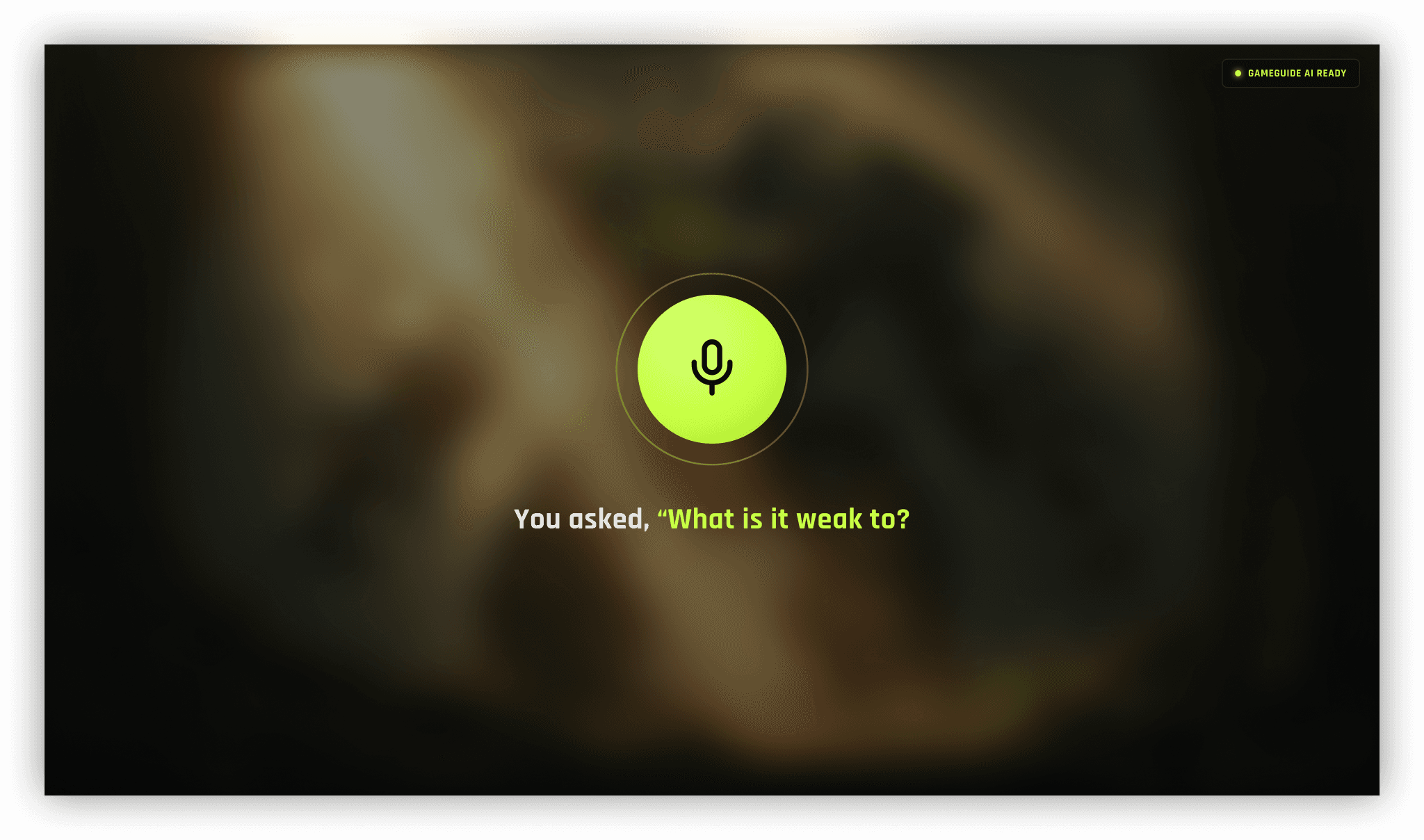
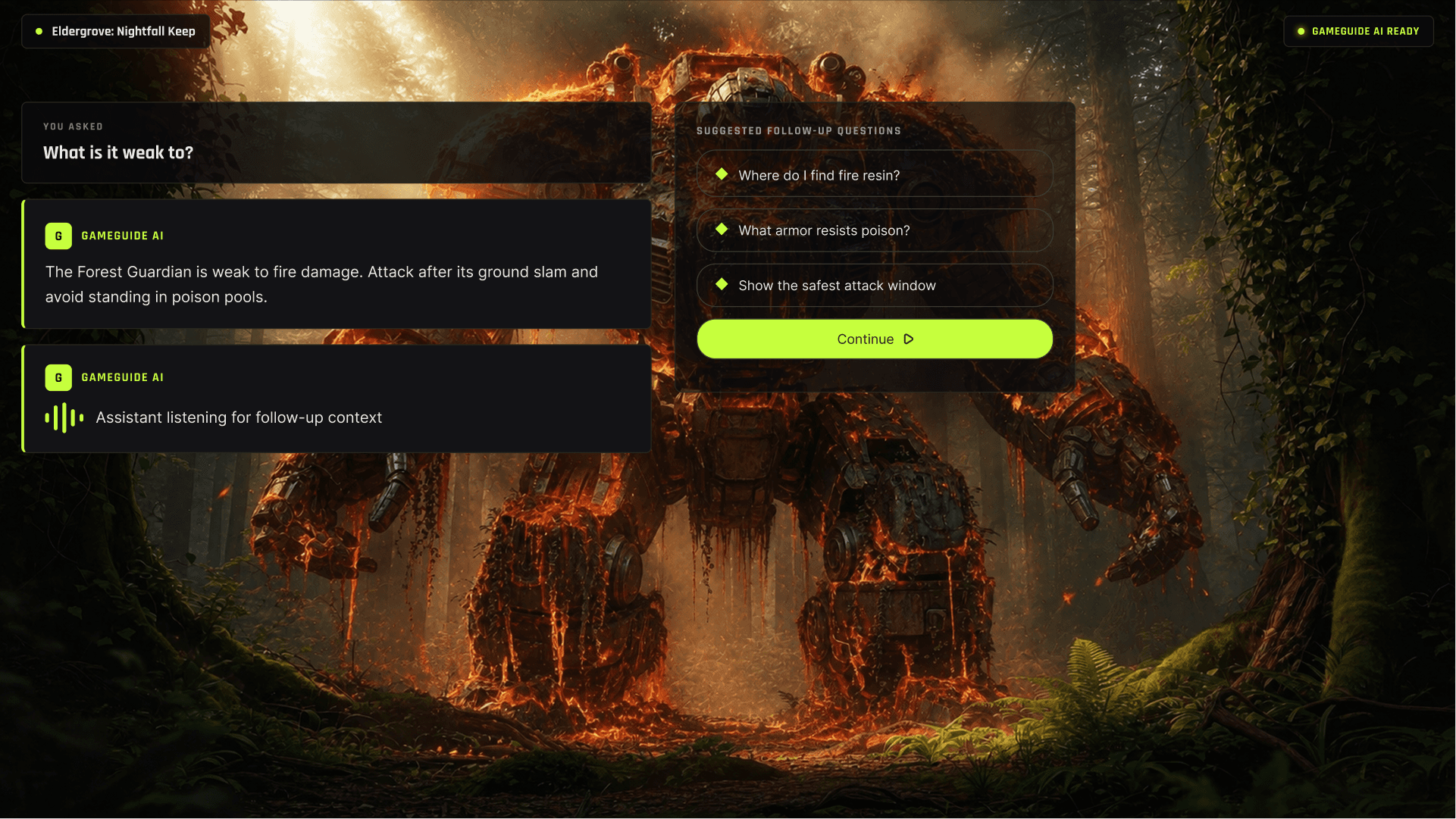
Raw AI output was refined against the brand system: decorative gradients became a flat dark surface with a single neon-green accent; generic fonts became the Rajdhani and Inter pairing; rounded corners became sharper HUD-like geometry. The live interaction loop moves from voice or controller trigger to contextual recommendation, then lets the player resume play.





08 / REFLECTION
Opportunities: AI gave speed with range, while cross-validating synthesized personas against real interviews produced a more honest outcome. Challenges: left unchecked, AI defaults to generic; it lacks innate IP awareness; and two interviews are a start, not proof.